Ratings & Reviews performance provides an overview of what users think of your app. Here are the key metrics to help you identify how your app is rated by users and how successful is your review management strategy.
 4.2
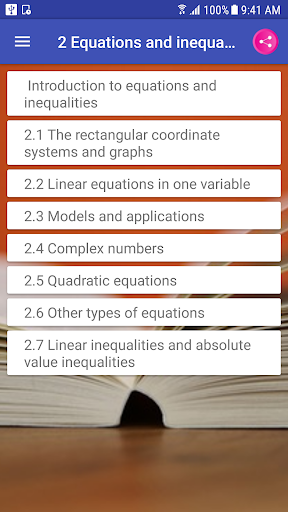
4.2Algebra and Trigonometry provides a comprehensive exploration of algebraic principles and meets scope and sequence requirements for a typical introductory algebra and trigonometry course. The modular approach and the richness of content ensures that the book meets the needs of a variety of courses. Algebra and Trigonometry offers a wealth of examples with detailed, conceptual explanations, building a strong foundation in the material before asking students to apply what they’ve learned. 1. Prerequisites 1. Introduction to prerequisites 1.1. Real numbers: algebra essentials 1.2. Exponents and scientific notation 1.3. Radicals and rational exponents 1.4. Polynomials 1.5. Factoring polynomials 1.6. Rational expressions 2. Equations and inequalities 2. Introduction to equations and inequalities 2.1. The rectangular coordinate systems and graphs 2.2. Linear equations in one variable 2.3. Models and applications 2.4. Complex numbers 2.5. Quadratic equations 2.6. Other types of equations 2.7. Linear inequalities and absolute value inequalities 3. Functions 3. Introduction to functions 3.1. Functions and function notation 3.2. Domain and range 3.3. Rates of change and behavior of graphs 3.4. Composition of functions 3.5. Transformation of functions 3.6. Absolute value functions 3.7. Inverse functions 4. Linear functions 4. Introduction to linear functions 4.2. Modeling with linear functions 4.3. Fitting linear models to data 5. Polynomial and rational functions 5. Introduction to polynomial and rational functions 5.1. Quadratic functions 5.2. Power functions and polynomial functions 5.3. Graphs of polynomial functions 5.4. Dividing polynomials 5.5. Zeros of polynomial functions 5.6. Rational functions 5.7. Inverses and radical functions 5.8. Modeling using variation 6. Exponential and logarithmic functions 6. Introduction to exponential and logarithmic functions 6.1. Exponential functions 6.2. Graphs of exponential functions 6.3. Logarithmic functions 6.4. Graphs of logarithmic functions 6.5. Logarithmic properties 6.6. Exponential and logarithmic equations 6.7. Exponential and logarithmic models 6.8. Fitting exponential models to data 7. The unit circle: sine and cosine functions 7. Introduction to the unit circle: sine and cosine functions 7.1. Angles 7.2. Right triangle trigonometry 7.3. Unit circle 7.4. The other trigonometric functions 8. Periodic functions 8. Introduction to periodic functions 8.1. Graphs of the sine and cosine functions 8.2. Graphs of the other trigonometric functions 8.3. Inverse trigonometric functions 9. Trigonometric identities and equations 9. Introduction to trigonometric identities and equations 9.1. Solving trigonometric equations with identities 9.2. Sum and difference identities 9.3. Double-angle, half-angle, and reduction formulas 9.4. Sum-to-product and product-to-sum formulas 10. Further applications of trigonometry 10. Introduction to further applications of trigonometry 10.1. Non-right triangles: law of sines 10.2. Non-right triangles: law of cosines 10.3. Polar coordinates 10.4. Polar coordinates: graphs 10.5. Polar form of complex numbers 10.6. Parametric equations 10.7. Parametric equations: graphs 10.8. Vectors 11. Systems of equations and inequalities 11. Introduction to systems of equations and inequalities 11.1. Systems of linear equations: two variables 11.2. Systems of linear equations: three variables 11.3. Systems of nonlinear equations and inequalities: two variables 11.4. Partial fractions 11.5. Matrices and matrix operations 11.6. Solving systems with gaussian elimination 11.7. Solving systems with inverses 11.8. Solving systems with cramer's rule 12. Analytic geometry 12. Introduction to analytic geometry 12.1. The ellipse 12.2. The hyperbola 12.3. The parabola 12.4. Rotation of axes 12.5. Conic sections in polar coordinates 13. Sequences, probability, and counting theory




![How to measure customer sentiment for app reviews [7 metrics]](https://cdn.appfollow.io/blog/static/appfollow_1335e02d-b0b3-49f7-9eb6-94171dc7e379.jpg)